
Home   »  Blog

Blog

Posts Tagged ‘media’

Audio - smartMeme & Friends on “Shifting the Landscape Towards Justice”

Thursday, May 20th, 2010

Two new Podcasts For your Listening Enjoyment…

Click to LISTEN: Part One :

Moderator: Laine Romero-Alston, Solidago Foundation; with Makani Themba-Nixon, Praxis Project; Doyle Canning, smartMeme; and Kathleen Pequeño, McKenzie River Gathering Foundation.

Click to LISTEN: Part Two :

Moderator: Helen Brunner, Quixote Foundation and Media Democracy Fund
 
Panel; with Karlos Guana Schmeider, Center for Media Justice; Patrick Reinsborough, smartMeme; Damekia Morgan, Community Media Organizing Project and Friends and Families of Louisana’s Incarcerated Children.

(Special thanks to Karlos @ the Center for Media Justice for posting this audio!)

This tele-strategy session series was organized by the Progressive Communicators Network, and brings together grassroots communications practitioners with a commitment to justice issues and funders who support justice and social movement efforts for a rare opportunity to think together about opportunities and imperatives to strengthen communications as a tool for change that will substantively impact U.S. culture, consciousness, and political policies.

This is a time of unprecedented change for grassroots communications practitioners. Factors such as the current economic crisis, rampant media consolidation, emerging new media technology and shift in administration bring unique and urgent challenges and opportunities. Faced with this changing communications landscape, grassroots justice organizations must make smart decisions about how to effectively communicate to advance their program and political work, often with fewer resources and confronted with changes in how media is made and news is communicated.
 
These times demand whole new approaches to change making and communication. It’s no longer enough to win individual victories, we must fundamentally shift our social, cultural and political ecology.

The Center for Media Justice, for example, has put out a call for a comprehensive and transformative approach to justice communications: Truly effective and sustainable movements for racial and economic justice must have the capacity, strategy, and leadership to advance a shared worldview and agenda, watchdog power, elevate strategic stories to a wider audience, increase engaged popular governance, and influence policy to change social conditions.They outline a powerful strategy that tackles race head on, brings the voices of the disenfranchised to the center, transforms public narratives, increases media access, and ultimately changes public consciousness and policy.

Join us to hear about these cutting edge strategies and more communications realities from across the country. We invite you to be part of creating the strategy and infrastructure that will boldly work to transform communications, change work, and the political realities of the 21st century.

10th National Gathering of the Progressive Communicators Network

Tuesday, June 23rd, 2009

I was so pleased to attend the 2009 national gathering of the Progressive Communicators Network (PCN), held in Chicago at the end of May. The conversations were rich, the connections were deep, and the insights were exquisite. What an amazing network!

Along with the great discussions (and party!), one of the highlights for me was the workshop on the story-based strategy model. We hadn’t done anything quite like this before. Patrick and I, with support from Anasa Troutman of the Movement Strategy Center, designed this session for this special group of skilled practitioners. It was such a wonderful challenge, and I felt myself growing into the moment. I was so humbled and honored to be in the space and share some of our “edge thinking.” And now you we can share it with you too!

Thanks to Nell Greenberg from Rainforest Action Network (who I recruited on-the-fly to shoot this low-fi video on our Flip Cam), the world can watch the workshop on smartmeme.blip.tv! Its about 45 minutes, and we go into some detail about the strategy model presented in RE:Imagining Change with examples to show each stage in the process….enjoy!

*You can download the slideshow from this presentation (its higher res than this video) at slideshare.net/smartmeme

* You can download the Story-based Strategy Campagin Model “Chart” handout HERE.

Pics from the workshop….

Anasa Troutman from the Movement Strategy Center opens the session on story-based strategy.

smartMeme workshop at the PCN national gathering, Chicago 2009

Doyle giving workshop at PCN national gathering, 2009 in Chicago

What PCN is all about:

PCN exists to strengthen and amplify the power, voices, and vision of grassroots movements that are working for racial, social, economic, and environmental justice. Network members use communication strategy, framing and messaging, and media tools to: 1) enhance the influence of social change movements on public policy and opinion; and 2) realize a world without poverty, racism, and other forms of oppression. The Network is a project of Spirit in Action, a movement-building support organization located in western Massachusetts.

A thousand THANK YOUs to the Progressive Communicators Network for bringing this amazing group together!

MAKE A DONATION TO PCN TODAY!

Progressive Communicators Network(ing)

Friday, August 1st, 2008

Last week I had the pleasure of meeting with members of the Boston-area Progressive Communicators Network. They host monthly learning events and invited me to speak about smartMeme’s approach to messaging and framing.

Based in western Massachusetts, PCN is a national network of organizers/communicators who:

“strengthen and amplify the power, voices, and vision of grassroots movements that are working for racial, social, economic, and environmental justice.”

PCN offers tools, networking, and an annual member convening to connect progressive communicators in order to enhance collaboration and advance the field of strategic communications. PCN also has active local groups, including one here in Boston.

About a dozen people came by to enjoy some burritos and conversation - and hailed from some amazing groups like the Student Immigrant Movement, United for a Fair Economy, Political Research Associates, Mass English Plus and the Unitarian Universalist Service Committee. It was inspiring to hear of the great social justice work that folks in the Boston area are doing, and have the opportunity to introduce myself (and smartMeme) to this community.

You can check out the slideshow I gave here (FYI some of the colors got tweaked in the slide-spacing process…)

After the slideshow we had the opportunity to talk, and the discussion was a rich reflection on the role of people’s history in story-based strategy. Often what we are facing is not lack of a story, but a ‘forgetting’ of history that is based in racism. As the antiracism principles of the Peoples’ Institute For Survival and Beyond remind us:

“History is a tool for effective organizing. Understanding the lessons of history frees us to create a more humane future.”

So many of the barriers that racial justice and social change communicators face are deeply related to an erasure of histories, and a dominant US media and school curriculum that often ignores (or is ignorant to) the centuries of struggle for social justice.

When we are communicating across race and class and waging the fight for justice, we are often struggling not just to reframe what’s happening in the present, but also name and reclaim what has happened in the past.

As any pop-psychologist will tell you, you can’t move forward into a better future without examining and understanding your story of your past - and the United States certainly has not reckoned with its history of genocide, slavery, conquest, and imperial interventions…

A related topic of discussion for the group was the story of the US civil rights movement, and that like many stories - it has become a “great man” story. While Dr Martin Luther King was undoubtedly an important leader, there were also countless individuals, particularly women (like Fannie Lou Hamer, Ella Baker, and many others) who were the muscle of the movement. (BTW I’ve Got the Light Of Freedom is an excellent peoples’ history of the Mississippi Freedom Struggle).

Some of the questions I was left with (as a social studies teacher by training and a smartMeme-er by trade):

As a diverse country, if we don’t know each others’ (and often our own) histories, how do we envision a shared future?

When/How must our movements wage the battle of the story over the past in order to foreshadow our story of the future?

Pop-culture narratives are celebrity-focused, but movements are powered by countless everyday people, so how do we both honor our leaders and hype all of the everyday heroes of our stories?

Thanks to PCN for the opportunity to offer our ideas, and have a provocative conversation. Thanks also to UFE for hosting!

*We hope to continue the conversation with another PCN learning event in the fall focused on using the battle of the story tool in practice. Be in touch if you’d like to attend!

Can we Reclaim the Legacy of Seattle?

Friday, July 11th, 2008

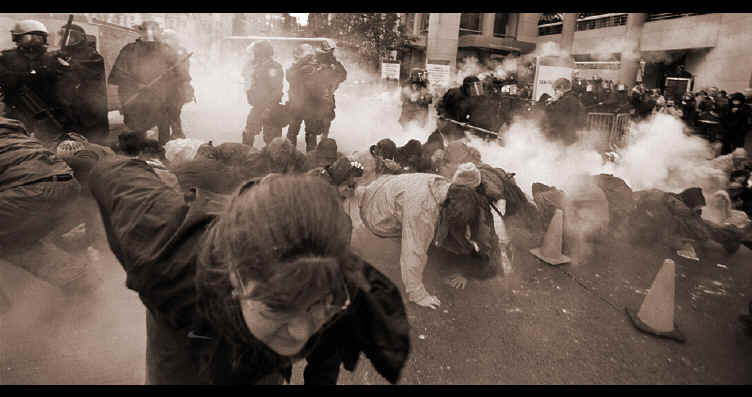
Nearly 10 years ago in late November 1999, I was one of the over 50,000 activists from different movements around the world who converged on Seattle to confront the World Trade Organization. We had come together to challenge the slickly packaged agenda of “free trade,” and the WTO’s effort to enshrine the power and profits of multinational corporations as the organizing principle of a new global order. The mass non-violent actions which shut down the opening day of the meeting (and the subsequent collapse of the Ministerial talks) marked a major milestone in the ongoing struggles for global justice, democracy, peace and ecological sanity.

Last week I had the surreal experience of re-living the actions as I attended an advance screening of the new feature length independent docu-drama called Battle in Seattle:

Naturally, the movie is far from perfect. It contains some typical cheesy cliches (particularly around gender) and its focus on a few central characters distorts the reality that actions like Seattle grew out of mass participation, decentralized decision-making and the underlying energy of broad social movements.

Nonetheless, the movie was so much better than I had expected it to be. The film contains over 9 minutes of archival footage that seamlessly blends into the movie and effectively recreates the look and feel of the actions. The film is a powerful depiction of the actions and is clearly anti-WTO, pro-mass action and culminates with a montage of global resistance that serves as a inspiring call to action.

Popular culture representations of social change struggles present both the opportunity to reach a wider, uninitiated audience - and the dangers of cooptation and distortion. When it comes to Seattle, the sad truth is that our movements have lost the Battle of the Story over the WTO protests. Unfortunately, the essential history and significance of Seattle and the subsequent global justice actions has largely failed to enter U.S. mass consciousness. Shoddy corporate journalism mis-labeled the WTO actions a “riot,” and despite a brief period of sensationalistic media coverage, the reporting largely ignored the underlying clash of values and ideas between global solidarity and corporate globalization. After 9-11, the U.S. corporate media delivered numerous public obituaries for the U.S. wing of a global movement of movements they had never really reported on, and the legacy of Seattle faded into the never ending onslaught of tabloidized 24 hour news cycles and reality TV shows.

So in 2008, what does this mean for us? The movie is fast paced, exciting and has a sprinkling of stars (Woody Harrelson as a violent cop, Charlize Theron as his wife, Ray Liotta as Seattle’s mayor, and Andre 3000 as one of the core activists). The anti-WTO message is clear, but the movie prioritizes being “entertaining.” All of this means the movie could succeed in reaching mass audiences inside the United States. If this movie is widely seen, it could spark broader conversation about corporate power, mass protest and the dynamics of how change is made. Although the exact social impact of a movie is difficult to gauge, it can certainly help us reclaim the legacy of Seattle and channel that energy into ongoing work for change. But only if we mobilize behind it…


Upcoming Events by Eventful


As the director (Irish actor Stuart Townsend) made clear to those of us at the screening, this movie can’t succeed on it own. The film is a small budget independent film, and after a year of disappointing experiences with distributors they are self-releasing. It does NOT have big Hollywood money behind it and it’s set to open in only 4 cities for a one week run on September 19th and then open in 10 more cities the following week. If — and ONLY if — it is commercially successful in those cities will it be released for mass distribution across the country. Essentially, in order for this movie to get widely seen it needs the support of progressive activists like you, and it needs it on those critical opening two weeks.

The film’s very small promotions crew is actually led by a Seattle WTO veteran, Harold Linde, who is one of the activists who helped hang the Rainforest Action Network’s famous WTO vs. Democracy banner (which is the opening sequence of the film.) As Harold explained, one of the best things people can do to help this movie succeed is to demand that local theaters play it.

Request a showing in your local community!

Share Your Seattle Stories!

The upcoming release of the film has also sparked another very important initiative to create a broader, multi-facted people’s history of the Battle in Seattle. This web based project has put an invitation out to all Seattle WTO veterans to post your stories and analysis of what happened at www.realbattleinseattle.org. The site has lots of great resources and links so check it out and post your story!

We may have lost the Battle of the Story around Seattle’s legacy, but it’s never too late to reclaim our stories! Between helping get the movie widely seen, and participating in projects like the people’s history website, we can hopefully reclaim some of that story and introduce new generations of activists to the joys of taking mass direct action for a better world.

More links for those unfamiliar or curious about the history and significance of the Seattle WTO protests:

Two great books that capture the legacy of Seattle and dispatches from the global movements against corporate power and exploitation are:

  • We are Everywhere: the Irresistible Rise of Global Anticapitalism edited by the Notes from Nowhere Collective
  • Globalize Liberation: How to Uproots the System and Build a Better World edited by David Solnit (and including several contributions from smartMeme’s Patrick Reinsborough)


Will You Join Us in the Middle of A Whirlwind?

Friday, June 20th, 2008

New from smartMeme : Story-based Strategies for Direct Action Design
SmartMeme is pleased to join Team Colors Collective and The Journal of Aesthetics and Protest Press in announcing the launch of the one-off online publication “In the Middle of a Whirlwind: 2008 Convention Protests, Movement and Movements”:

www.inthemiddleofawhirlwind.info

Whirlwinds provides detailed analysis, thoughtful criticism, and substantive writing on current organizing through an inquiry into movement in the United States. Through that process, Whirlwinds assembles a strategic analysis of current political composition as a tool for building political power.

SmartMeme was asked to offer some analysis on how to integrate narrative strategy into the realm of street protest, with an eye towards demonstrations at this summer’s political conventions. We responded with a brief but detailed explanation of story-based strategy elements, and ideas for “direct action at the point of assumption.”

In addition to our own submission, some of our favorite snippets of this anthology include:

Harmony Goldberg on The Right to The City Alliance:

This expansive approach to anti-gentrification organizing reflects the Right the City Alliance’s movement-building orientation. The alliance is not interested in a narrow definition of the issue; instead they want to foster a resistance that is as complex and wide-ranging as the process of gentrification itself.

Marina Karides on the US Social Forum:

The establishment of the USSF process relied on repeated transaction or tasks accomplished by various members of the National Planning Committee that started the process of establishing trust. And this trust developed beyond traditional activist sectors, extending networks outside of their “quarters” or issues. The future of building a program of collaborative social justice in the US will rely on groups and organizations extending beyond their usual body politics and into building alliances with other sectors and political leanings.

and our very own Jen Angel on Media & Activism:

All types of media contribute to discussions around social movements in their own unique and valuable ways.

What I’ve come to believe can be summarized in several points:

• Media is central to how power operates

• Media is integral to advancing the work of social justice movements

• Media is a tool to be used strategically by activists

• Activists need to prioritize and fund media

• Activists need to directly connect our activism and media to struggles and communities

• We need to meet the needs and appeal to the desires of individuals and communities

This collection begins and end with the question:

Will you join us in the middle of a whirlwind??

Visit the Whirlwinds Site

Download the PDF - Story-Based Strategies for Direct Action Design

Whose Media? Our Media!

Tuesday, June 10th, 2008

New from smartMeme: Changing the Story for Media Justice!

smartMeme was invited to collaborate with the SPIN Project on their newly released toolkit Whose Media? Our Media! - Strategic Communications Tools to Reform, Reclaim, and Revolutionize the Media

In communities across the country, inspiring campaigns of resistance and transformation are standing up to powerful corporations and bought-and-paid-for-politicians. The Battle of the Story is being waged daily to determine whether our collective mediascape will be a sterile corporate monoculture or a vibrant ecosystem of diverse voices and perspectives….
~ From Patrick Reinsborough’s contribution, It’s Time to Change the Story!

The Whose Media? Tool Kit is an impressive, comprehensive, change agent How-To Guide. Packed with tips, analyses and best practices, Whose Media? Our Media! walks you through the tools of strategic communications – planning, framing, messaging, creative campaign tactics — and offers special spotlights on digital media/Web 2.0, Ethnic Press and Funding the Work.

Whether you are a seasoned activist, or someone new to the movement trying to get your story out, this tool kit is an invaluable ally in the battle of the story.

smartMeme Says:

Don’t Leave Home / Take on Corporate Media

Without It!

You Can Download the Toolkit Here: [Download PDF (1.8 MB)]

Or order hard copy from SPIN.
*If you are a member of an organization that works for media reform or media justice, you are eligible to receive a free copy of this kit! If you would like a copy of this kit but do not fit the above criteria, you may order the kit for $15.00 (includes shipping and handling).

ENJOY!