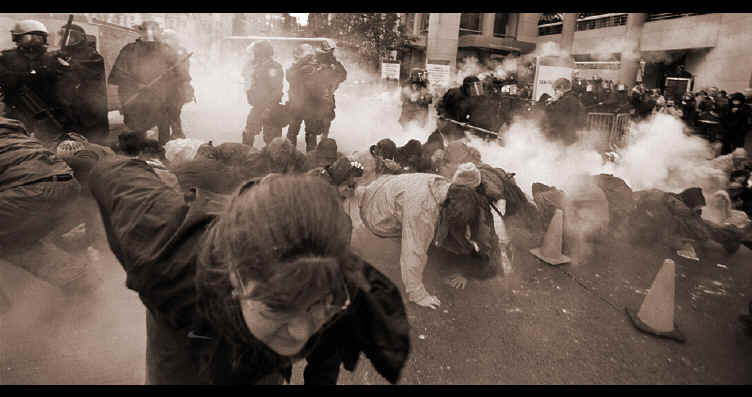
I don’t know about you, but I’m feeling like this economic meltdown moment is a game-changer. The recent firestorm over the “bailout” is the beginning of a whole new conversation about our economic system, the role of the state, and extreme wealth and inequality. It is also clearly not the end of our economic woes, and things are likely going to get worse before they get better.
The recent revelations of economic trouble have produced a barrage of memes in the media and popular culture: meltdown, bailout, rescue package, and Wall Street vs. Main Street. Now, leaders tell us that we are in the midst a new economic reality – a credit crunch, foreclosure crisis, a recession, or another Great Depression.
Even as lawmakers struggle to reframe the $700 billion package as a “Rescue,” the “Bailout” meme remains more potent. The story of free market fundamentalism is unraveling, and the story has changed – but to what?
What does all of this mean for progressive strategy, and what are the stories we can tell about the real impacts and alternatives?
We’ve been glued to the news and talking to friends at partner groups like the Working Group on Extreme Inequality, the Design Studio 4 Social Intervention, and the Rainforest Action Network about what’s happening and what can be done. We’ve been inspired by efforts by groups like City Life/Vida Urbana and the Greenlining Institute. Last week I gathered with members of the Progressive Communicators Network at United For a Fair Economy in Boston to analyze the battle of the bailout story. At the PCN gathering, we also discussed what may come of the bailout and efforts to sway government, and listed the following Possible Outcomes:
- Lives are repaired: Meet needs of impacted people (people in foreclosure get refinancing etc)
- Political change: Obama is elected as a result of Bush’s economic bungles
- Changes in economic systems: Regulations are put in place, rules are changed, new definitions of economic progress are adopted
- Movement Emerges: Grassroots social movement gains ground
We had widespread agreement on these as potential goals for work in this period, and specifically discussed how these goals are not incompatible. We agreed that if we get into debates about which of these should be the most important goal, we lose sight of the gravity of this moment. All of the above is on the table. Everything could change.
The following is a rough narrative analysis of the landscape around the economic crisis using the battle of the story tool. We’re obviously just scratching the surface. I have also created a PDF VERSION battle of the bailout story for easier printing. PLEASE use this work in ways that are useful, and let us know what you think!
________________________________________________________________________________________________
PART I:
Power Holder Story: Collapse vs. Rescue
* This story uses fear to motivate action, and uses the “blame the few bad apples” frame to gloss over systemic problems.
The US way of life is threatened, and so we must act immediately. Democratic capitalism is the greatest system, and America is the greatest nation, and so even though we believe in the free market, we must intervene to save our economy. We must put partisanship and electioneering aside and make this rescue deal now – or face economic collapse.
Yes, there were some greedy individuals on Wall Street and some rouge lenders who went too far. Liberals like Barney Frank and big government caused this problem. With laws like the Community Reinvestment Act and the quasi-public Fannie Mae and Freddie Mac, government forced banks to make risky loans to minorities and low-income people who had no business buying houses. People irresponsibly borrowed to buy big houses that they just could not afford, and were living far outside of their means. Now these mortgages are troubled assets for the nation’s major financial institutions, and this means that everyone is in danger in this financial crisis.
This is not just a bailout for Wall Street. There is a crunch in the credit market, and so we are all in the same boat now. Small businesses that borrow money for payroll or holiday inventory are having trouble getting loans they rely on each year. The Dow is dropping by the day and the trading floors are reeling. Banks are hoarding cash and we’re facing the highest inter-bank overnight loan rate ever. Markets in Asia and Europe are affected. We cannot listen to these constituents who don’t understand the complexities of the economy and are mis-interpreting this plan. We all need access to credit and if we don’t pass this rescue package, the experts say that the gears of the economy will stop turning and you could lose your job. The US could lose our standing in the world as the major economic power, and our nation could be thrust into an economic recession akin to the Great Depression. Besides, since the package is to buy these securities at a low rate, the taxpayers can even make the money back when the housing market rebounds.
Conflict –
Collapse vs. Rescue
The US way of life is threatened
Things just got out of hand, and we must act now
Characters –
A few greedy, corrupt Wall Street bankers
Irresponsible borrowers living outside their means
Ignorant, reactionary taxpayers
Expert Economists
Bush-Paulson-Bernanke
Barney Frank & Nancy Pelosi: Bipartisans = Heroic selfless politicians
Warren Buffet
Liberal Congressmen: forced lenders to lend to people who shouldn’t be borrowing
Images –
Lehman Bros offices closing – bankers with cardboard boxes of their stuff packed up
Bad Paper = Toxic Waste
Banks in Crisis – hoarding cash
“Black Box” of investments
Meltdown
Desperate chaos on the Trading floors
Graph of market going down by the hour
DC gridlock around the clock– lawmakers up all night with pizza and Thai takeout
Foreshadowing -
Great Depression
Economic Collapse
We’re all to blame, we’re all in this together, and we’re all going to benefit
Core memes –
Meltdown
Rescue (or Bailout)
Economic Collapse
Crisis
Buy in (not Bailout)
Underlying Assumptions -
We need Wall Street
It’s Now or Never!
The market will fix itself (after the $700 billion)
This is a crisis of confidence, and the rescue will reestablish confidence
It’s everyone’s problem now
It’s like a natural disaster, coming out of nowhere; no one could have predicted it
US is entitled to be a superpower and take drastic action to protect our privileges
You’re either with us or against us
A bunch of poor people/people of color/stupid people had no business buying houses and ruined everything
________________________________________________________________________________________________
PART II: Change Agents Story
Casino Capitalism (risk) vs. American Dream (security)
Greed Economy vs. Green Economy
* This story attempts to explain why the crisis came to be, and tie solutions into a larger progressive agenda. It’s a little long, and repetitive, but attempts to offer some ways to explain the situation in a larger context.
While a handful of billionaires have been getting very rich playing in the Wall Street casino, real wages for the rest of us in the real economy have stagnated, and personal debt has ballooned. The economic growth of the last several decades has been bubble/debt driven, rather than based on real increases in wages – and this has been Washington’s policy. While honest people have been borrowing to get by, Wall Street has been seeking high returns on speculative high risks, and has been biding their time in a dangerous game of game of chicken. Bear Sterns cried out first, and by the time AIG said “uncle”, Bernenke was there with a $700 billion bailout for the entire financial sector.
But our livelihood is not a game, and this crisis didn’t happen overnight: the $700 billion dollar bailout of the bankrupt banks was a predictable outcome of decades of policy driven by greed and an ideology that says “government, get out of the way.” Drastic action is needed – but we can’t throw a trillion dollars at the people who made the problem and expect them to fix it. We need to modernize our economic system and launch the next (green) new deal – a massive reinvestment in job creation, clean energy, and opportunity that can save the American dream from foreclosure.
 The cascading implosion of major banks is the result of decades of flawed policy based on the myth that greed on Wall Street is good for everyone. This myth has shaped the economic policies of Regan and Bush, and drove Clinton to deregulate investment banks to link mortgages to the stock market and repeal Depression Era reforms designed to protect us from the risks of financial speculation. It is tempting to blame the financial crisis on a few greedy hedge funders, or even on the millions of debtors in over their heads with sub-prime mortgages. But the culprit is an ideology that has had a death grip on our country for the last 20 years, and allowed this pyramid scheme of predatory lending to spiral out of control under the Bush Administration.
The problem is more than “no one was minding the store.” The fat cats bought off their friends and Washington and turned the store into a casino. There was so little government oversight that they could shred the rules, and make up new ones as they went along. In a capital-induced frenzy, they invented new games, new ways to bet, and gambled other people’s money to profit hand over fist. The government not only let this happen – it made it all possible and celebrated it as progress.
Now the Wall Street casino has been exposed as a house of cards atop mountains of debt. As their pyramid scheme comes crashing down it threatens to devastate the real economy that provides jobs, food and opportunity for the rest of us. Bailing out America means more than buying banks – it means keeping Americans in our homes, offering a health care system that doesn’t bankrupt our families, building thriving local economies that provide honest work, and retro-fitting our nation to deal with the energy crisis.
We face an economic crisis in the midst of two wars, global warming, and a health care system in desperate need of repair. As the proverb goes – in crisis there is opportunity. Now is the time to change course: re-regulate, re-invest, and re-finance to build a green economy that houses, insures and employs every American.
Conflict -
Casino Capitalism (risk) vs. American Dream (fairness & security)
Reckless Speculators vs. Honest everyday Americans
Greed Economy vs. Green Economy
Out-of-control/recklessness vs. stability/responsibility
Crisis vs. Opportunity
Wall Street vs. Main Street (this frame is about who gets the money, not about why the crisis is happening)
Real Economy (Life Values and Community Needs) vs. Speculative Economy (Money Values and Corporate Greed)
Characters -
Wall Street - Greedy Hedge Funders
Predatory mortgage brokers
2 million people in foreclosure
Impacted people: unemployed, uninsured, over stretched, in debt
Reagan, Bush I, Clinton, Bush II
Images -
Game of Chicken
Saying Uncle
Casino / games / gambling
Liquor cabinet of capital
Top-heavy system falling over
Implosion
Debt bubble: House as ATM machine
Families forced out of homes
Imaginary money
Foreclosure Pickets
House of cards
Mountains of debt
Foreshadowing -
Next New Deal – people working in jobs that matter: energy overhaul (windmills, weather stripping, solar, rail)
Real Economic Recovery
Turn the Countrywide office into a job training facility
Micro credit lending; tell stories about people investing in people; micro-enterprises that create good jobs in local communities
Core Memes –
Next New Deal
Green New Deal
Pyramid scheme
Casino capitalism
Predatory lending
Honest work
House of cards
Crisis = Opportunity
Underlying Assumptions-
This is a crisis of capitalism
This crisis embodies institutional racism, and the predatory sub-prime market targeted communities of color. Efforts to lay the blame on borrowers is a play on racist assumptions.
People in power always manage the economy – this was deliberate mismanagement
We share collective responsibility for the well being of all – solutions must address the needs of everyone
This is a pivotal moment that could mean opportunity to overhaul the financial system and change stories on related issues: global warming, health care, ending the occupation, economic inequality, etc.
This crisis is also an ecological wakeup call. If we don’t change the real bubble that will pop is our planet…
_________________________________________________________________________________________________
Brainstorm: Possible Points of Intervention for nonviolent action
Production: Organizing workers in the financial institutions
Decision: Action in Washington, Protest at the Capitol, Birdogging on the Campaign Trail, Appearences by financial industry execs
Destruction: Picketing foreclosure proceedings
Consumption: Action at the storefronts of major banks
Point of assumption: Telling a new story on Wall Street (dramatic actions at the Bull). Transforming sub-prime lender storefronts into something more helpful for communities. Launching major people-to-people micro-credit exchanges in public spaces. Exposing the assumption that hard times are the result of individual circumstances—bringing people together to share stories and find common experiences, forming alliances of mutual aid.
?


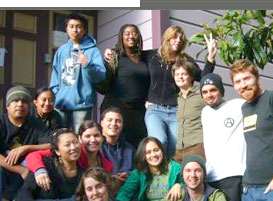


 first ever advanced training, supported Occupy Wall Street, and ordered the third printing of

 e on any notion of raising taxes on the wealthy or discussing economic inequality. The Occupy Wall Street movement breathed new life into this old school meme with lasting implications for our political climate.


 As movements around the planet mobilize to counter the effects of climate destabilization on their communities, cultures, and ecosystems, a framing battle of global significance is underway.
 Hand in hand with the story of the all-powerful market is the obsession with techno-fixes. Techno-fixes masquerade as solutions but just distract us from making the fundamental changes that are needed. The assumption that some benign “experts” will provide new, innovative technology to solve the problem justifies continuing unsustainable policies while removing people’s agency from the frame. More and more climate techno-fixes are being proposed: from overt lies like “clean coal” and “climate ready” genetically engineered crops to terrifyingly disruptive, untested new technologies like synthetic biology and geoengineering.[i] Beware!
 Climate justice framing is challenging the control myths above (and many more) by refocusing the issue on the core problems of fossil fuel addiction, the ongoing legacy of historic inequities and the need for systemic change. At the center of the evolving narrative is the role of community-based solutions in stewarding a just transition towards a society that is both sustainable and just. As different movements like migrants rights, reproductive justice and organized labor articulate the connections between their struggles and the climate crisis there are many opportunities to experiment with applying and broadening climate justice framing.