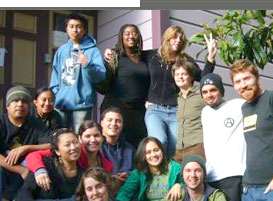
This 4 day training was 2 days on framing/story-based strategy w/ smartMeme, and 2 days of fun w/ the Flip Cams and Tweet-decks making mock campaign videos and online campaigns, with Jen Caltrider.
I took the opportunity to learn more about using final cut pro, an made this video blog about the summer camp!
I had a wonderful time working with all these beautiful, incredible, bold and brilliant organizers - and innovating the story-based strategy curriculum to mesh with viral video production and online campaigning. It was tons of fun, and I learned a ton too.
THANKS to PTP and all who made this amazing training possible!
A quick reflection on our 2009 convening on climate change, creative actions, social justice and the “Copenhagen Moment”…
I am so thrilled about the “Pause,” a restorative and rigorous retreat we convened last week. I am deeply grateful for all who attended, supported, and donated to make this event possible. It was truly a special occasion, gathering some amazing climate activists who are approaching the crisis from a justice perspective, and working to build movements at the intersections of ecology and social justice. We were also joined by our amazing video team (justinfrancese.com) and kitchen magicians (delicata catering). The beautiful Bluewater Farm in Andover, NH (traditional Pennacook Territory) was generously donated for this event. Check out pics…
The sessions involved narrative power analysis and discussions of the dominant frames on the climate crisis; climate justice principles; the UNFCCC negotiations in Copenhagen later this year; and creative ideas for how to spread memes for climate justice.
We also had a celebration on Tuesday evening, and were blessed with local special guests from the Winter Center for Indigenous Traditions (dedicated to environmental justice, Abinaki indigenous rights and cultural practices), and local CSA organic farmer Katherine Darling, of Two Mountain Farm.
Fireside chats and formal sessions included discussions of the upcoming G20 meeting in Pittsburg, stories from past UNFCCC talks in Bali and Poznan, reflections on race and racism in the environmental field, and visioning for how to build an inclusive movement that addresses the root causes of the climate crisis.
As I write this blog, I am recalling this experience and simultanously struck by the stakes. Listening to this mornings news from the G8 Summit in Italy, I hear the voice of Phil Radford, executive director of Greenpeace USA:
“It’s almost diagnosing your child with cancer but not taking the kid to the doctor. It just doesn’t seem like good leadership, and I think people expect better of President Obama and other world leaders.”
Then, the sobering words of Ken Lieberthal of the Brookings Institution (?):
“I think it’s going to be very, very hard to avoid a catastrophe, so I think anyone who looks very seriously at this issue has to say that the future looks very, very sobering.”
Indeed.
The Road to Copenhagen is hot, long, and treacherous. But we make the road by walking…
Below is an excerpt of a report-back on the retreat by some of the participants…
The retreat intended to focus on how to do more effective framing and messaging around climate justice, following the smartMeme model of challenging underlying cultural assumptions (you can download their new manual for free at smartmeme.org). On the first day we heard some presentations about smartMeme’s messaging strategy and ‘narrative power analysis’ (see the manual for a more in-depth explanation of this), as well as some strategies that have been used by Action Mill and Design Studio for Social Intervention, a community organizing group in Boston. There were some brainstorming sessions to “get the creative juices flowing,” and some short presentations about Environmental Justice/Climate Justice principles, the COP-15 process, the Mobilization for Climate Justice and other organizing underway.
The second day the group wanted to get deeper into concerns of numerous people present on the watering down of the term “climate justice” and its conflation with climate action, which is not necessarily based in justice (carbon offsetting, for example)…
All in all, while the retreat was not exactly what I expected, it was the unexpected conversations that I found most valuable and thought-provoking. And the facilitators did an excellent job of being flexible and serving the many changing needs of the group. Oh, and I forgot to mention the food was AMAZING. Mainly, it was great just to connect with so many awesome folks, and be able to have some of the hard (but
so necessary) conversations around how to build a movement across boundaries of race, class, and culture. Only by hearing each other and working through this stuff will we ever stand a chance of building the sort of broad-based movement that actually has the power to bring about systemic changes…
It has taken me far too long to post this, but I feel strongly that smartMeme community will enjoy this important conversation.
On Febuary 25th, the Boston Chapter of the Progressive Communicators Network convened a panel discussion called “Talking About Racial & Economic Justice in Obama’s America.” After some fairly crude sound editing, I managed to upload the recordings of the panelists for your listening enjoyment!
Amaad Rivera [LISTEN]is the director of the racial wealth divide program at United for a Fair Economy, and lead author on their 2009 State of the Dream Report: The Silent Depression. He discusses Racism without Racists, patterns of school segregation in Boston, and building racial justice frameworks.
“views racism at the individual level (e.g. Lines of reasoning such as “I don’t own slaves” or “I have very close black friends” to defend oneself) without looking at the larger social mechanisms in which racism operates.”
Ramos presents a facsinating discussion of Bonilla-Silva’s frames of color blind ideology, and how these play out in affirmative action fights: Minimization (“Yes, there is some racism but its no big deal”); Cultural Failings (“Mexicans have too many babies; Blacks don’t value education,” etc.); Naturalization (“Its natural for people to flock together. Its not segregation.”); and Meritocracy (“Its unfair for government to advance one race over another; treaty rights/civil rights are special rights.”)
Ramos says that these four frames reinforce each other and hold racism in place, and he points to the work of the Center for Social Inclusion to suggest that audiences need an alternative frame of “Structural Racism” to buck the colorblind mythology.
Doyle Canning [LISTEN] (that’s me), discusses some of the stories in the popular culture on racism and “post racism,” and how story-based strategies can work to challenge some of the underlying assumptions of white supremacy in the dominant culture.
I strongly recommend watching this amazing roundtable on the topic on Laura Flander’s GRITtv:
Manning Marable’s comments (10 minutes into the video) are particularly powerful in terms of thinking about the power of narrative and history. He speaks about the stories we carry in our head as we’re walking through the world depending on our history: Marable sees lower Manhattan as a slave trading port, while others (whites) see Wall Street’s glittering façade.
This gets to the heart of the internalization of racism. The Peoples’ Institute for Survival and Beyond discusses the interconnected principles of learning from history and addressing the inter-generational processes of internalized racial superiority and inferiority.
I believe that story-based strategies can help us build movements for racial justice, but it really is about movement building. If only it were as easy as coming up with a pat sound-byte to address these deep seeded cultural currents! It still takes struggle, as it always has.
One piece of work I want to point to specifically is work on unmasking and undoing White Privilege, such as the first annual White Privilege Awareness Week!
Maureen Dowd wrote in her NY Times OP-Ed on Holder’s speech,
“In the middle of all the Heimlich maneuvers required now — for the economy, Iran, Pakistan, Afghanistan, health care, the environment and education — we don’t need a Jackson/Sharpton-style lecture on race. Barack Obama’s election was supposed to get us past that.”
My observation is that this is the line of reasoning often used in white-led liberal organizations (“We’ve got a crisis and so much work to do…we can’t deal with this now…and besides, we have some people of color involved.”) about why we can’t talk honestly about racism and work to address racism within our movements…Just a thought.
Growing Food and Justice for All Initiative (GFJI) held their inaugural gathering in Wisconsin last weekend and welcomed over 100 people into a conversation about dismantling racism and growing food justice. Food Justice is the meme of the movement to build a fair and ecological food system that nourishes soils, feeds all people, and builds communities of self-determination.
SmartMeme was there to participate and offer a story-based
strategy workshop titled Re-Framing Food: Changing the Story for
Justice. Thanks to all of you who attended! You can check out the
presentation here….
Are you hungry for justice? Do you love local, organic, delicious food?
Bring your passions together at the table, and join me and smartMeme board member Shana Mc-Davis Conway at the First Annual Gathering of the newly launched Growing Food and Justice for All Initiative (GFJI): September 18-21 at the Wisconsin State Fair Grounds in West Allis, Wisconsin.
Food connects culture, health, the land, and the people - but in this fast food nation (where food is getting more globalized, genetically-modified, high carbon, and expensive), we’ve got to step up and strengthen the movement to bring food back to an ecological, human scale. The inspiring trend is that farmers markets are re-emerging in many communities, and organic food is the fastest growing segment in the food industry - but the critical question is, who can (and can’t) afford it?
In the age of global warming, and in a time where 12.6 million children are going hungry in the United States, the future demands that we nourish the Earth and our bellies with a re-imagined food system built on the principles of ecology, and racial & economic justice.
This upcoming gathering is 3 days of doing just that. We are looking forward to delicious, local food — critical conversations about how racism shapes the food system — stories from community-based organizations who are doing something about it — and seeing YOU there!
The Growing Food and Justice for All Initiative (GFJI) is
a new network aimed at dismantling racism and empowering low-income and communities of color through sustainable and local agriculture. The network views dismantling racism as a core principle which brings together social change agents from diverse sectors working to bring about new, healthy and sustainable food systems and supporting and building multicultural leadership in impoverished communities throughout the world. The vision for this initiative is to establish a powerful network of individuals, organizations and community based entities all working toward a food secure and just world
A main course of workshops includes:
What It Means to Be White: Working towards full-awareness of white- privilege in community food security work:Judging by a quick scan of the demographics of people leading urban agriculture projects in low-income communities of color around the country, white women seem to be particularly drawn to this type of work. Within the good intentions of many white women (and men) often lie unexamined negative assumptions. This interactive workshop will explore cross-class and/or inter-racial partnerships…
Grassroots Leaders Fight for Justice in the Food System: The experience of racism in the food system can best be lifted by those who have lived it. We also are the ones on the ground finding solutions in an unjust system. Our multicultural panel will briefly describe our experience, work, barriers, achievements, and plans, with emphasis on successful work led by people of color in the food system….
and our smartMeme workshop -
Re-Framing Food, Changing the Story for Justice:People just buy junk with Food Stamps. Genetically modified crops will feed the poor. Community Gardens are for white hippies/Organics are for yuppies. America means justice for all. The intersecting narratives of poverty, race, and food create a complex mine-field of messages in the dominant culture that all of our work must struggle to re-frame and transform. We will use story as a method to approach framing our issues, and have an honest conversation about our successes, and what is holding back our efforts to create change…
Hungry for more?
A keynote from Winnona LaDuke (Founder White Earth Land Recovery Project and Anishinaabeg (Ojibwe) enrolled member of the Mississippi Band. She has won numerous awards for her indigenous rights work, and written five books including Last Standing Woman and All Our Relations.)
and a potluck of great ideas from smartMeme community friends like:
Last week I had the pleasure of meeting with members of the Boston-area Progressive Communicators Network. They host monthly learning events and invited me to speak about smartMeme’s approach to messaging and framing.
Based in western Massachusetts, PCN is a national network of organizers/communicators who:
“strengthen and amplify the power, voices, and vision of grassroots movements that are working for racial, social, economic, and environmental justice.”
PCN offers tools, networking, and an annual member convening to connect progressive communicators in order to enhance collaboration and advance the field of strategic communications. PCN also has active local groups, including one here in Boston.
About a dozen people came by to enjoy some burritos and conversation - and hailed from some amazing groups like the Student Immigrant Movement, United for a Fair Economy, Political Research Associates, Mass English Plus and the Unitarian Universalist Service Committee. It was inspiring to hear of the great social justice work that folks in the Boston area are doing, and have the opportunity to introduce myself (and smartMeme) to this community.
You can check out the slideshow I gave here (FYI some of the colors got tweaked in the slide-spacing process…)
After the slideshow we had the opportunity to talk, and the discussion was a rich reflection on the role of people’s history in story-based strategy. Often what we are facing is not lack of a story, but a ‘forgetting’ of history that is based in racism. As the antiracism principles of the Peoples’ Institute For Survival and Beyond remind us:
“History is a tool for effective organizing. Understanding the lessons of history frees us to create a more humane future.”
So many of the barriers that racial justice and social change communicators face are deeply related to an erasure of histories, and a dominant US media and school curriculum that often ignores (or is ignorant to) the centuries of struggle for social justice.
When we are communicating across race and class and waging the fight for justice, we are often struggling not just to reframe what’s happening in the present, but also name and reclaim what has happened in the past.
As any pop-psychologist will tell you, you can’t move forward into a better future without examining and understanding your story of your past - and the United States certainly has not reckoned with its history of genocide, slavery, conquest, and imperial interventions…
A related topic of discussion for the group was the story of the US civil rights movement, and that like many stories - it has become a “great man” story. While Dr Martin Luther King was undoubtedly an important leader, there were also countless individuals, particularly women (like Fannie Lou Hamer, Ella Baker, and many others) who were the muscle of the movement. (BTW I’ve Got the Light Of Freedom is an excellent peoples’ history of the Mississippi Freedom Struggle).
Some of the questions I was left with (as a social studies teacher by training and a smartMeme-er by trade):
As a diverse country, if we don’t know each others’ (and often our own) histories, how do we envision a shared future?
When/How must our movements wage the battle of the story over the past in order to foreshadow our story of the future?
Pop-culture narratives are celebrity-focused, but movements are powered by countless everyday people, so how do we both honor our leaders and hype all of the everyday heroes of our stories?
Thanks to PCN for the opportunity to offer our ideas, and have a provocative conversation. Thanks also to UFE for hosting!
*We hope to continue the conversation with another PCN learning event in the fall focused on using the battle of the story tool in practice. Be in touch if you’d like to attend!