




Can we Reclaim the Legacy of Seattle?
July 11th, 2008 by patrickNearly 10 years ago in late November 1999, I was one of the over 50,000 activists from different movements around the world who converged on Seattle to confront the World Trade Organization. We had come together to challenge the slickly packaged agenda of “free trade,” and the WTO’s effort to enshrine the power and profits of multinational corporations as the organizing principle of a new global order. The mass non-violent actions which shut down the opening day of the meeting (and the subsequent collapse of the Ministerial talks) marked a major milestone in the ongoing struggles for global justice, democracy, peace and ecological sanity.
Last week I had the surreal experience of re-living the actions as I attended an advance screening of the new feature length independent docu-drama called Battle in Seattle:
Naturally, the movie is far from perfect. It contains some typical cheesy cliches (particularly around gender) and its focus on a few central characters distorts the reality that actions like Seattle grew out of mass participation, decentralized decision-making and the underlying energy of broad social movements.
Nonetheless, the movie was so much better than I had expected it to be. The film contains over 9 minutes of archival footage that seamlessly blends into the movie and effectively recreates the look and feel of the actions. The film is a powerful depiction of the actions and is clearly anti-WTO, pro-mass action and culminates with a montage of global resistance that serves as a inspiring call to action.
Popular culture representations of social change struggles present both the opportunity to reach a wider, uninitiated audience - and the dangers of cooptation and distortion. When it comes to Seattle, the sad truth is that our movements have lost the Battle of the Story over the WTO protests. Unfortunately, the essential history and significance of Seattle and the subsequent global justice actions has largely failed to enter U.S. mass consciousness. Shoddy corporate journalism mis-labeled the WTO actions a “riot,” and despite a brief period of sensationalistic media coverage, the reporting largely ignored the underlying clash of values and ideas between global solidarity and corporate globalization. After 9-11, the U.S. corporate media delivered numerous public obituaries for the U.S. wing of a global movement of movements they had never really reported on, and the legacy of Seattle faded into the never ending onslaught of tabloidized 24 hour news cycles and reality TV shows.
So in 2008, what does this mean for us? The movie is fast paced, exciting and has a sprinkling of stars (Woody Harrelson as a violent cop, Charlize Theron as his wife, Ray Liotta as Seattle’s mayor, and Andre 3000 as one of the core activists). The anti-WTO message is clear, but the movie prioritizes being “entertaining.” All of this means the movie could succeed in reaching mass audiences inside the United States. If this movie is widely seen, it could spark broader conversation about corporate power, mass protest and the dynamics of how change is made. Although the exact social impact of a movie is difficult to gauge, it can certainly help us reclaim the legacy of Seattle and channel that energy into ongoing work for change. But only if we mobilize behind it…


Upcoming Events by Eventful
As the director (Irish actor Stuart Townsend) made clear to those of us at the screening, this movie can’t succeed on it own. The film is a small budget independent film, and after a year of disappointing experiences with distributors they are self-releasing. It does NOT have big Hollywood money behind it and it’s set to open in only 4 cities for a one week run on September 19th and then open in 10 more cities the following week. If — and ONLY if — it is commercially successful in those cities will it be released for mass distribution across the country. Essentially, in order for this movie to get widely seen it needs the support of progressive activists like you, and it needs it on those critical opening two weeks.
The film’s very small promotions crew is actually led by a Seattle WTO veteran, Harold Linde, who is one of the activists who helped hang the Rainforest Action Network’s famous WTO vs. Democracy banner (which is the opening sequence of the film.) As Harold explained, one of the best things people can do to help this movie succeed is to demand that local theaters play it.
Request a showing in your local community!
Share Your Seattle Stories!
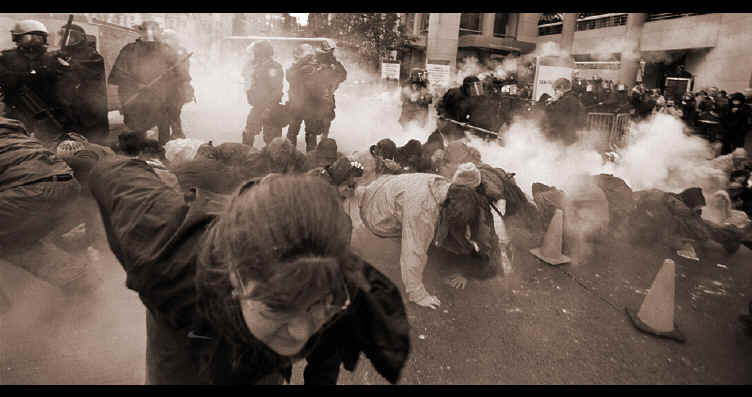
The upcoming release of the film has also sparked another very important initiative to create a broader, multi-facted people’s history of the Battle in Seattle. This web based project has put an invitation out to all Seattle WTO veterans to post your stories and analysis of what happened at www.realbattleinseattle.org. The site has lots of great resources and links so check it out and post your story!
We may have lost the Battle of the Story around Seattle’s legacy, but it’s never too late to reclaim our stories! Between helping get the movie widely seen, and participating in projects like the people’s history website, we can hopefully reclaim some of that story and introduce new generations of activists to the joys of taking mass direct action for a better world.
More links for those unfamiliar or curious about the history and significance of the Seattle WTO protests:
- The Big Noise Films documentary This is What Democracy Looks Like
- The anthology The Battle of Seattle: the New Challenges to Capitalist Globalization edited by Eddie Yuen, George Katsiaficas and Daniel Burton Rose
- SmartMeme’s Doyle Canning’s reflections on the Seattle actions can be found in the book Letters from Young Activists
Two great books that capture the legacy of Seattle and dispatches from the global movements against corporate power and exploitation are:
- We are Everywhere: the Irresistible Rise of Global Anticapitalism edited by the Notes from Nowhere Collective
- Globalize Liberation: How to Uproots the System and Build a Better World edited by David Solnit (and including several contributions from smartMeme’s Patrick Reinsborough)
Tags: activism, analysis, corporate globalization, corporate power, global justice, history, media, movements, popular culture, Seattle, WTO