Home   »  Blog

Blog

Posts Tagged ‘strategy’

SmartMeme in London, U.K. July 31 Workshop

Wednesday, July 14th, 2010

Calling all our U.K. friends and allies!

We’re honored to be hosted by the venerable creative action, arts and campaigning organization PLATFORM for a brief presentation and interactive workshop about smartMeme’s tools and strategic approach as documented in our new book Re:Imagining Change.

How to win ‘the battle of the story’ in campaigning, movement organizing and changing the world!

An introduction to using story-based strategy

When: Saturday 31st of July, 3pm to 6pm

Where: The Stephen Lawrence Centre, 39 Brookmill Road, London, SE8 4HU

Cost: Suggested donation of £3 to cover the room hire. No one turned away for lack of funds.

Reserve a spot: Places are limited. To reserve your place, please email your confirmation to [email protected] with one sentence about what group/project/organisation you are involved with. We are trying to ensure that there is a diverse set of participants/groups represented on the day.

Workshop Description:
Storytelling has always been central to the work of activists, organizers and movement builders. Narrative is the lens through which humans process the information we encounter, be it cultural, emotional, experiential, or political. We make up stories about ourselves, our histories, our futures, and our hopes.
SmartMeme draws from many disciplines, integrating practices from organizing, broadcast media, advertising, strategic communications, education and systems thinking into their strategy and training work. Their experiments have evolved into a set of tools they call story-based strategy — a framework to link movement building with an analysis of narrative power by placing storytelling at the centre of social change strategy.

This workshop on the 31st of July, given by smartMeme co-founder Patrick Reinsborough will introduce some of the basic techniques in how to use story-based strategy as a tool in achieving social change. The workshop is aimed at people involved in social movements, community organizing, direct action groups, progressive NGOs and anyone who is interested in engaging with them.

Building the Movement for Mother Earth

Tuesday, June 8th, 2010

Reflections on Cochabamba, Geoengineering, and Framing the Climate Crisis on the Road to Cancun…


The news this week from the climate negotiations in Bonn, Germany suggests that the world is on track for a catastrophic 4-degree increase in temperatures by 2100. (Four degrees Celsius in temperature rise renders our planet essentially unrecognizable and unlivable.) This is a frightening forecast for what’s in store on the road to COP 16, the next round of international climate negotiations slated for December 2010 in Cancun, Mexico.

But there is another road to Cancun, made by social movements who attended the historic Cochabamba Peoples’ World Conference on Climate Change and the Rights of Mother Earth in April. The Cochabamba conference was convened by Bolivian President Evo Morales in the wake of the failure of the Copenhagen talks and the regressive agenda laid out by the United States and their allies in the so-called ‘Copenhagen Accord.’ (For my take on Copenhagen see the April/May issue of Left Turn Magazine). Cochabamba was an attempt to stake out another pole in the international climate discourse, led by Southern governments and social movements, that pins the responsibility for climate change directly on the over-consumptive northern countries and transnational corporations, and asserts the rights of Mother Earth.

From Copenhagen to Cochabamba

At the invitation of the Bolivia UN Mission in New York, I had the great honor of attending historic Cochabamba meeting, and accompanied the delegation of Grassroots Global Justice and the Indigenous Environmental Network (IEN).

SmartMeme’s main piece of work at Cochabamba was to support IEN’s organizing around forest-offset schemes known as REDD (Reducing Emissions from Deforestation and Degradation). Carbon offset schemes like REDD are opposed by peasant movements and Indigenous Peoples around the world on the grounds that these programs are designed to create a multi-billion dollar market for transnational corporations, while displacing forest-dependent communities and making no meaningful impact on slowing climate change. (For a great introduction to forest offset impacts in Brazil, see the new 20-minute film from Frontline, “The Carbon Hunters.”)

The REDD struggle is a critical front of the global Indigenous Peoples human rights struggle – this is ultimately a multi-billion dollar scheme to move Indigenous Peoples out of their traditional homelands and lease those forests to polluting industry to enable them to continue to pollute. At the heart, this is the struggle against the commodification of nature, and a struggle to assert that trees, air, and people’s homes and life ways cannot be traded in a marketplace to offset pollution.

Unlike Copenhagen, the Cochabamba conference elevated these kinds of concerns about the human rights impacts of both climate change and climate policy, and proposed strong negotiating positions (50% emission reduction under the Kyoto Protocol in the upcoming Cancun COP-16 talks, and targeting 1 – 1.5 degrees C of warming).

The good news is that the Cochabamba conference rejected REDDs and “market mechanisms that violate the rights of Indigenous Peoples, States, and Nature.” The conference adopted a Peoples’ Accord on the Rights of Mother Earth with strident, strong positions on the necessary actions to safeguard the future and build a just transition off of fossil fuels.

The bad news is Bonn, and that the United States has essentially committed to do nothing to fundamentally address the climate crisis in terms of transitioning off of fossil fuels. As we enter this next round of climate negotiations at COP 16 with the sunset on this edition of the Kyoto Protocol looming in 2012, now is the time for the climate justice movement to be rethinking our framing. We are losing critical ground while extreme proposals like geoengineering (i.e. planetary engineering) are gaining support using the narrative of government inaction and a quick fix.

Description Embeds Prescription

The Cochabamba conference was titled, “The World Peoples Conference on Climate Change and the Rights of Mother Earth,” and this framing – The Rights of Mother Earth – was the most enticing and provocative aspect of this historic meeting for smartMeme. Indigenous Peoples and social movements gathered together under this banner, combining a rights-based frame with the affirmation of our sacred relationship with the planet, and the pan-Indigenous creed of respect for Mother Earth (or “Pachamama” in much of the Andes).

As we all know, global warming is happening at an alarming rate, and changes are inevitable. Weather patterns are changing, and countless ecosystems and communities are impacted directly – from the Arctic to Africa to the Amazon. Dramatic, comprehensive, collective action must be taken…the fight now is about What kind of action? Who decides? Who profits? And who pays?

From a framing perspective, how define the problem is inseparable from how we imagine the solution. As my colleague and design studio-mate Kenneth Bailey says, in a design process “description embeds prescription.” The way we cognitively pattern the problem determines what solutions are possible – and in the climate justice fight, this is at the heart of the battle for the story.

The Carbon Fundamentalist Narrative

To borrow a meme from my colleague (and smartMeme board member) Gopal Dayenenni at Movement Generation, the pervasive mindset in climate politics is steeped in “carbon fundamentalist” narrative. This story insists that the problem we are facing is merely a surplus of atmospheric carbon, and the way to deal with it is to effectively manage the amount of carbon being omitted, ideally by reduction, but if that proves politically infeasible, then through offsets. This problem-solution-action frame has given rise to the international carbon market – and the carbon-offset-industrial-complex. It also leads to obsession with charts, bright lines, and light bulbs, and the murky logic of techno-fix proposals that will magically save us without ever having to lift a finger to phase out fossil fuels.

An underlying assumption of this narrative is that carbon emissions are disconnected from place. This story says “We are in a global crisis, so pollution from a coal plant in Kentucky is the same as anywhere else, and carbon-eating trees in Brazil can make up for it.”

While the message that we have a surplus of carbon is not untrue, it is hardly meaningful for people, which limits its effectiveness on a narrative level. The carbon fundamentalist narrative is also inherently problematic as it focuses on emissions in the abstract, disconnected from the eco-systems, neighborhoods and nations where fossil fuels are mined and burned (most often poor communities and communities of color), and where offset projects displace people and disrupt communities (most often in the rural global South).

It also is carbon-blind – seeing all carbon as the same, weather it comes from Exxon-Mobil or a Brazilian farmer’s diesel tractor – which leads to policy solutions that are ahistorical and unjust, and do not address the roots of the problem: the fossil fuel industry. If we focus exclusively on carbon, we lose the focus on real places and real people, and on the real culprits.

This narrative is very dangerous, and is getting more so. As the international climate negotiations falter, and with four-degrees in the sightlines of Bonn, false-solutions and geoengineering mega-projects are gaining more and more traction.

The Urgency Frame & Geoengineering

The carbon-fundamentalist narrative has increasingly co-opted the “urgency frame.” As the crisis escalates and the window for meaningful action is closing, environmentalists and others are ringing the alarm bells ever louder. Campaigns like “TckTckTck” emphasize that time is running out, and frame around the lack of time and the severity of the crisis.

And there is no doubt, the situation is urgent. It is very urgent, especially in Alaska Native territories, in Sub-Saharan Africa, Tuvalu, or anywhere on the Gulf Coast. But what is of concern to me is that the urgency frame does nothing to explain the roots of the problem and is thus easily co-opted by any big, dramatic so-called “solution,” regardless if it is just, or even if it is a good idea.

The carbon fundamentalist narrative coupled with the urgency frame actually enables and promotes proposals like geoengineering, proposals that are gaining a lot of traction from philanthropists, venture-capitalists, and governments in the lead up to Cancun.

Now, what do we mean by “geoengineering”? Our friends at the ETC Group explain in their 2009 report “Retooling the Planet”:

Geoengineering is the intentional, large-scale intervention in the Earth’s oceans, soils and/or atmosphere, especially with the aim of combating climate change. Geoengineering can refer to a wide range of schemes, including: blasting sulfate particles into the stratosphere to reflect the sun’s rays; dumping iron particles in the oceans to nurture CO2 -absorbing plankton; firing silver iodide into clouds to produce rain; genetically-engineering crops so their foliage can better reflect sunlight.

University of Calgary physicist and geoengineering advocate, David Keith, describes geoengineering as “an expedient solution that uses additional technology to counteract unwanted effects without eliminating their root cause.” In other words, geoengineering uses new technologies to try to rectify the problems created by the use of old technologies, a classic techno-fix.

The Geoengineers in Bolivia and Beyond

In addition to 17,000 people from social movements across the world, a bold trio of geoengineering proponents from a company called CloudWorld.co.uk also attended the Cochabamba conference, hoping to gain support for their plan to release sulfates into the atmosphere above the Arctic. We had a heated conversation about how to best address the climate crisis.

Their logic was straightforward, and chillingly compelling:

The climate crisis is reaching a point-of-no return.

We must save the Arctic, or before warming sets off an irreversible feedback loop that will push the planet over the edge.

The only way to save the Arctic, and the world, is to shield the ice from the sun.

The way to do that is to mimic a volcano, clouding the atmosphere to shade the ice.

At this point, geoengineering has to be part of the program in order to avert humanitarian catastrophe.

Their story fits right into the urgency frame, is mired in the carbon fundamentalist narrative, and is nestled in the underlying assumptions of the dominant culture:

  • Earth is a machine,
  • The hubris that humans can fix the machine, and
  • No one else will act and so a smart (white) man must go rogue and save the world (a la a Hollywood movie.)

But this is a disaster movie.

And the scary thing is – it’s not too far from reality. The ETC group reports that In March 2010, 175 geoengineers met at Asilomar California to establish “voluntary guidelines” for real world geoengineering experiments. The meeting was convened by a body associated with a private geoenginering company called Climos Inc who aims to carry out ocean fertilization trials. Other companies and groups in attendance made it clear that they also hoped to see real-world field trials in the near future.

And the field trials are happening. On May 8th, the Times of London revealed that a company called Silver Lining – backed by the world’s richest man Bill Gates – would be conducting field trials for their “cloud bleaching” project in the Pacific Ocean.

The Times story begins:

“The first trials of controversial sunshielding technology are being planned after the United Nations failed to secure agreement on cutting greenhouse gases.”

That framing is revealing of the narrative equation that is starting to define the climate landscape: government inaction + urgency = geoengineering.

Hands Off Mother Earth!

Fortunately there weren’t too many takers for geoegineering in Cochabamba. I attended a fantastic side event by the ETC Group, which launched their new campaign called Hands Off Mother Earth (HOME). This new campaign calls on the UN for a worldwide ban on geoengineering, and reframes away from carbon, and towards the larger living system of Mother Earth, on which we all depend.

The Hands Off Mother Earth campaign features an interactive website where individuals can ‘lend a hand’ to the campaign, leaving messages and uploading images of themselves. The site features a public portrait gallery of individuals with open palms calling a halt to geoengineering.

“With rich governments and industrial interests jockeying for open-air geoengineering tests it is time to draw a line that should not be crossed.” affirmed Silvia Ribeiro of ETC Group, Mexico. “Mother Earth is our common home whose integrity should never be violated by geoengineering experimentation - it should never be a laboratory for these risky and unjust schemes.”

HOME is already achieving success! Due to the great work by ETC and their allies, a proposal for a geoengineering moratorium will go to the UN Convention on Biological Diversity at its next meeting in Nagoya, Japan this October.

I hope you will join me and smartMeme in this campaign by adding your hand to the photo-gallery, and lending your support to grassroots movements for climate justice that are addressing the root causes of climate change and building solutions from the ground up.

From Broken Machine to Mother Earth

If we are to succeed in debunking and halting dangerous false-solutions like REDDs and stop geoengineering, we must also fundamentally shift the framing of the climate crisis – away from the idea that the planet is an overheating machine, and towards the assertion that we are all interdependent on the living systems of Mother Earth.

The Cochabamba conference has helped the world to hear this message, but while the relationship with “Mother Earth” has always been central for Indigenous Peoples, can the “Mother Earth” meme reach the hearts and minds of the rest of the U.S. public? Perhaps with 50+ days of the tragic BP oil spill, consciousness is shifting – but we’ve got a long road beyond Cancun to make the necessary fundamental changes in the fossil fuel economy and the US culture of cheap oil dependence.

As COP 16 approaches, we must continue to resist carbon-fundamentalism and offer a new narrative of Climate Justice that can inspire transformative social change and protect the rights of Mother Earth, while blowing open the assumption – especially here in the US — that there will be a quick techno-fix that can save our planet.

The challenge for Climate Justice leaders now is to tell a better story of ecological justice and the real solutions that can transition us off fossil fuels for good. From Cochabamba to Cancun and beyond, we must change the story from techno-fix to fundamental change, and build the peoples’ movement for Mother Earth.


Book Release Party: May 4 @ Bella Luna in Boston

Wednesday, April 28th, 2010

Re:Imagining Change

Book Release Celebration

Join us to Celebrate the Release of smartMeme’s New Book!

Re:Imagining Change — How to Use Story-based Strategy to Win Campaigns, Build Movements and Change the World (2010 PM Press)

With co-author Doyle Canning, Board member Amaad Rivera, and Special Guests!

Tuesday May 4th at Bella Luna/Milky Way (at the Brewery) in Jamaica Plain, MA.

6 pm Happy Hour

7 pm Reading and Author Q & A, Book signing, and conversation

Party with us till 9 pm!
Re:Imagining Change (published by PM Press) is an inspiring and accessible resource guide to smartMeme’s innovative story-based strategy tools and methodology. The book grows out of smartMeme’s work since 2002, training over 3,000 activists and collaborating with over 100 social change organizations on a wide range of critical environmental and social justice issues. Re:Imagining Change outlines how to apply narrative power analysis to effectively frame issues, provides intriguing case studies, and issues a passionate call for more creative movement building to face the intersecting crises of the 21st century.

SmartMeme co-founder Doyle Canning will briefly share some of the insights from the book, followed by Q&A and discussion.

Don’t miss this evening of celebration, strategy, and storytelling!

PS. If you can’t make it but want to check out the book you can order it online at http://www.smartMeme.org/book

NOTE: Major discount for bulk purchases are available (10 or more copies) for grassroots organizations.

Bella Luna/Milky Way is always a good time! See you there!

REVerb Summer Camp with Progressive Tech Project

Tuesday, July 28th, 2009

Enjoy some scenes from the 2009 REVerb Summer Camp with the Progressive Technology Project, somewhere in Minnesota!

This 4 day training was 2 days on framing/story-based strategy w/ smartMeme, and 2 days of fun w/ the Flip Cams and Tweet-decks making mock campaign videos and online campaigns, with Jen Caltrider.

Groups at the camp included SCOPE from Los Angeles, Southwest Organizing Project (SWOP) from Albuquerque, Kentuckians for the Commonwealth, Data Center, POWER from the San Francisco Bay Area, NY City AIDS Housing Network, and TN Immigrant and Refugee Rights Coalition from Nashville.

I took the opportunity to learn more about using final cut pro, an made this video blog about the summer camp!

I had a wonderful time working with all these beautiful, incredible, bold and brilliant organizers - and innovating the story-based strategy curriculum to mesh with viral video production and online campaigning. It was tons of fun, and I learned a ton too.

THANKS to PTP and all who made this amazing training possible!

See also — Pics from the week via Flickr…

www.flickr.com

smartMeme’s RE:Verb Summer Camp with the Progressive Technology Project photoset

RE:Imagining (Climate) Change

Friday, July 10th, 2009

A quick reflection on our 2009 convening on climate change, creative actions, social justice and the “Copenhagen Moment”…

I am so thrilled about the “Pause,” a restorative and rigorous retreat we convened last week. I am deeply grateful for all who attended, supported, and donated to make this event possible. It was truly a special occasion, gathering some amazing climate activists who are approaching the crisis from a justice perspective, and working to build movements at the intersections of ecology and social justice. We were also joined by our amazing video team (justinfrancese.com) and kitchen magicians (delicata catering). The beautiful Bluewater Farm in Andover, NH (traditional Pennacook Territory) was generously donated for this event. Check out pics…

www.flickr.com

smartMeme’s Invoking the Pause: smartMeme conveing on climate and social justice photoset

The sessions involved narrative power analysis and discussions of the dominant frames on the climate crisis; climate justice principles; the UNFCCC negotiations in Copenhagen later this year; and creative ideas for how to spread memes for climate justice.

We also had a celebration on Tuesday evening, and were blessed with local special guests from the Winter Center for Indigenous Traditions (dedicated to environmental justice, Abinaki indigenous rights and cultural practices), and local CSA organic farmer Katherine Darling, of Two Mountain Farm.

Fireside chats and formal sessions included discussions of the upcoming G20 meeting in Pittsburg, stories from past UNFCCC talks in Bali and Poznan, reflections on race and racism in the environmental field, and visioning for how to build an inclusive movement that addresses the root causes of the climate crisis.

As I write this blog, I am recalling this experience and simultanously struck by the stakes. Listening to this mornings news from the G8 Summit in Italy, I hear the voice of Phil Radford, executive director of Greenpeace USA:

“It’s almost diagnosing your child with cancer but not taking the kid to the doctor. It just doesn’t seem like good leadership, and I think people expect better of President Obama and other world leaders.”

Then, the sobering words of Ken Lieberthal of the Brookings Institution (?):

“I think it’s going to be very, very hard to avoid a catastrophe, so I think anyone who looks very seriously at this issue has to say that the future looks very, very sobering.”

Indeed.

The Road to Copenhagen is hot, long, and treacherous. But we make the road by walking…

Below is an excerpt of a report-back on the retreat by some of the participants…

Here is a report-back from a strategy retreat convened by smartMeme that I attended last week (called “The Pause”) to discuss climate justice issues & messaging. There were about 15 or so folks in attendance, all invited by smartMeme or other attendees. The folks who came were connected with various orgs with a major focus on either climate justice or environmental justice: Environmental Justice Climate Change Initiative (EJCC), Indigenous Environmental Network, Action Mill, Avaaz.org Climate Action, Katrina to Copenhagen, Global Justice Ecology Project, Rainforest Action Network, The Ruckus Society, Movement Generation, DS4SI and Northeast Action.

The retreat intended to focus on how to do more effective framing and messaging around climate justice, following the smartMeme model of challenging underlying cultural assumptions (you can download their new manual for free at smartmeme.org). On the first day we heard some presentations about smartMeme’s messaging strategy and ‘narrative power analysis’ (see the manual for a more in-depth explanation of this), as well as some strategies that have been used by Action Mill and Design Studio for Social Intervention, a community organizing group in Boston. There were some brainstorming sessions to “get the creative juices flowing,” and some short presentations about Environmental Justice/Climate Justice principles, the COP-15 process, the Mobilization for Climate Justice and other organizing underway.

The second day the group wanted to get deeper into concerns of numerous people present on the watering down of the term “climate justice” and its conflation with climate action, which is not necessarily based in justice (carbon offsetting, for example)…

All in all, while the retreat was not exactly what I expected, it was the unexpected conversations that I found most valuable and thought-provoking. And the facilitators did an excellent job of being flexible and serving the many changing needs of the group. Oh, and I forgot to mention the food was AMAZING. Mainly, it was great just to connect with so many awesome folks, and be able to have some of the hard (but
so necessary) conversations around how to build a movement across boundaries of race, class, and culture. Only by hearing each other and working through this stuff will we ever stand a chance of building the sort of broad-based movement that actually has the power to bring about systemic changes…

10th National Gathering of the Progressive Communicators Network

Tuesday, June 23rd, 2009

I was so pleased to attend the 2009 national gathering of the Progressive Communicators Network (PCN), held in Chicago at the end of May. The conversations were rich, the connections were deep, and the insights were exquisite. What an amazing network!

Along with the great discussions (and party!), one of the highlights for me was the workshop on the story-based strategy model. We hadn’t done anything quite like this before. Patrick and I, with support from Anasa Troutman of the Movement Strategy Center, designed this session for this special group of skilled practitioners. It was such a wonderful challenge, and I felt myself growing into the moment. I was so humbled and honored to be in the space and share some of our “edge thinking.” And now you we can share it with you too!

Thanks to Nell Greenberg from Rainforest Action Network (who I recruited on-the-fly to shoot this low-fi video on our Flip Cam), the world can watch the workshop on smartmeme.blip.tv! Its about 45 minutes, and we go into some detail about the strategy model presented in RE:Imagining Change with examples to show each stage in the process….enjoy!

*You can download the slideshow from this presentation (its higher res than this video) at slideshare.net/smartmeme

* You can download the Story-based Strategy Campagin Model “Chart” handout HERE.

Pics from the workshop….

Anasa Troutman from the Movement Strategy Center opens the session on story-based strategy.

smartMeme workshop at the PCN national gathering, Chicago 2009

Doyle giving workshop at PCN national gathering, 2009 in Chicago

What PCN is all about:

PCN exists to strengthen and amplify the power, voices, and vision of grassroots movements that are working for racial, social, economic, and environmental justice. Network members use communication strategy, framing and messaging, and media tools to: 1) enhance the influence of social change movements on public policy and opinion; and 2) realize a world without poverty, racism, and other forms of oppression. The Network is a project of Spirit in Action, a movement-building support organization located in western Massachusetts.

A thousand THANK YOUs to the Progressive Communicators Network for bringing this amazing group together!

MAKE A DONATION TO PCN TODAY!

Podcast: Racial Justice Communications in Obama’s America

Friday, April 17th, 2009

It has taken me far too long to post this, but I feel strongly that smartMeme community will enjoy this important conversation.

On Febuary 25th, the Boston Chapter of the Progressive Communicators Network convened a panel discussion called “Talking About Racial & Economic Justice in Obama’s America.” After some fairly crude sound editing, I managed to upload the recordings of the panelists for your listening enjoyment!

Amaad Rivera [LISTEN] is the director of the racial wealth divide program at United for a Fair Economy, and lead author on their 2009 State of the Dream Report: The Silent Depression. He discusses Racism without Racists, patterns of school segregation in Boston, and building racial justice frameworks.

Tarso Luís Ramos [LISTEN] is the director of research at the right-wing watchdog group Political Research Associates. He discusses the work of Ian F. Haney Lopez’s on “colorblind white dominance,” Eduardo Bonilla-Silva’s work on White Supremacy and Racism in the Post-Civil Rights Era, and the “Color Blind Ideology.”

Color-Blindness:

“views racism at the individual level (e.g. Lines of reasoning such as “I don’t own slaves” or “I have very close black friends” to defend oneself) without looking at the larger social mechanisms in which racism operates.”

Ramos presents a facsinating discussion of Bonilla-Silva’s frames of color blind ideology, and how these play out in affirmative action fights: Minimization (“Yes, there is some racism but its no big deal”); Cultural Failings (“Mexicans have too many babies; Blacks don’t value education,” etc.); Naturalization (“Its natural for people to flock together. Its not segregation.”); and Meritocracy (“Its unfair for government to advance one race over another; treaty rights/civil rights are special rights.”)

Ramos says that these four frames reinforce each other and hold racism in place, and he points to the work of the Center for Social Inclusion to suggest that audiences need an alternative frame of “Structural Racism” to buck the colorblind mythology.

Doyle Canning [LISTEN] (that’s me), discusses some of the stories in the popular culture on racism and “post racism,” and how story-based strategies can work to challenge some of the underlying assumptions of white supremacy in the dominant culture.

The most potent meme of the moment was the “Nation of Cowards” from Eric Holder’s speech on systemic racism.

I strongly recommend watching this amazing roundtable on the topic on Laura Flander’s GRITtv:

Manning Marable’s comments (10 minutes into the video) are particularly powerful in terms of thinking about the power of narrative and history. He speaks about the stories we carry in our head as we’re walking through the world depending on our history: Marable sees lower Manhattan as a slave trading port, while others (whites) see Wall Street’s glittering façade.

This gets to the heart of the internalization of racism. The Peoples’ Institute for Survival and Beyond discusses the interconnected principles of learning from history and addressing the inter-generational processes of internalized racial superiority and inferiority.

I believe that story-based strategies can help us build movements for racial justice, but it really is about movement building. If only it were as easy as coming up with a pat sound-byte to address these deep seeded cultural currents! It still takes struggle, as it always has.

One piece of work I want to point to specifically is work on unmasking and undoing White Privilege, such as the first annual White Privilege Awareness Week!

Also, in terms of racial justice communications specifically, check out the guide “Talking The Walk,” edited by Hunter Cutting and Makani Themba-Nixon (download the toolkit!); and the Center for Media Justice toolkit, Communicate Justice 101. See also: A Three-Ring Circus On Race This Week by Paul Rosenburg.

And one more thing…

Maureen Dowd wrote in her NY Times OP-Ed on Holder’s speech,

“In the middle of all the Heimlich maneuvers required now — for the economy, Iran, Pakistan, Afghanistan, health care, the environment and education — we don’t need a Jackson/Sharpton-style lecture on race. Barack Obama’s election was supposed to get us past that.”

My observation is that this is the line of reasoning often used in white-led liberal organizations (“We’ve got a crisis and so much work to do…we can’t deal with this now…and besides, we have some people of color involved.”) about why we can’t talk honestly about racism and work to address racism within our movements…Just a thought.

Report-Back: Capitol Climate Action

Tuesday, March 17th, 2009

Two weeks ago I was in the streets with thousands of friends, old and new, for the historic Capitol Climate Action (Check out my pics on FLICKR!) SmartMeme endorsed this action, and I was excited to support the effort by helping to create messages for the action’s banners, training participants in nonviolent direct action , and being a “contingent coordinator” with the awesome Blue Team.
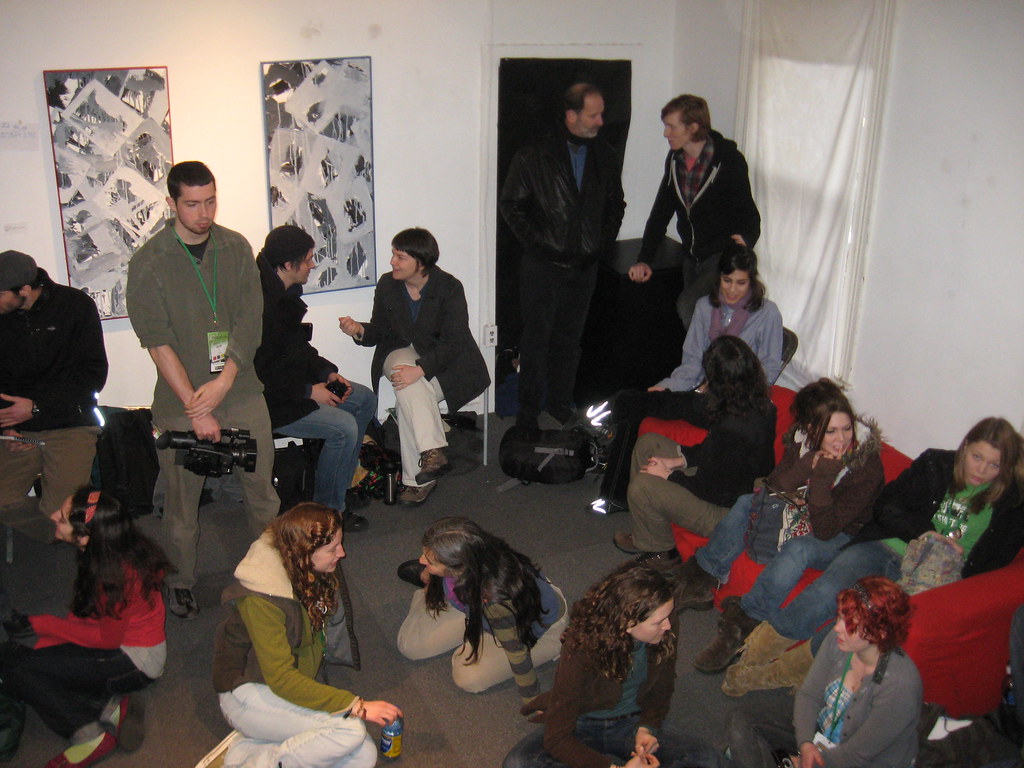
Honestly, I had a ball! The action was well organized, colorful, and upbeat despite the cold temperatures. My nonviolence training session was packed - with a dozen participants showing up 30 minutes early to ensure they got a spot, and a line going out the door when the room was full. 95% of that group were first timers to nonviolent protest, and they were fired up and ready to stop coal and solve global warming.

The action was endorsed by a large and diverse community of organizations, and attention was made to amplifying the voices of directly-impacted people. Leading the march were residents of Appalachian communities being blown-up by the Coal Industry; Indigenous delegations from Black Mesa and Michigan (where five new coal fired power plants are proposed), and leaders from Chicago’s Little Village Environmental Justice Organization, who are fighting for clean air against coal fired power plants. They were joined by celebrities and prominent environmental leaders like Bill McKibben and Wendell Berry, and the executive directors of the convening groups. The majority of participants were students (mostly white), many of them taking action in the streets for the first time.

Action Logic

The Capitol Coal Plant was a smart venue for this event. It comes with built in symbolism and implicit story-based strategy. The plant is powered by coal to warm and cool our nation’s Capitol building. The concept of the action was to draw attention to the fact that coal-fired power is fueling climate destabilization, and highlight the utterly destructive life cycle of coal, from mining to slurry to smog. It was also a way to point to the heavyweight influence that the coal industry has over all of Capitol Hill. Symbolically this was a perfect stage for our play.

But two unexpected things happened that took the story off the script.

1. Days before the protest, Speaker of the House Nancy Pelosi and Senate Leader Harry Reid released a letter asking the Capitol Architect to switch the Capitol Power Plant from coal to 100 percent natural gas by the end of 2009.

Organizers responded saying that this was a victory, showing the power of grassroots mobilization to get the attention of power holders. This hardly took the wind out of our sails, but did complicate the frame. The discussion emerged in my nonviolence training about whether this shift even was a victory: “Natural gas is also a fossil fuel.” “The problem is the whole coal/oil/fossil fuel paradigm.” “One symbolic concession is a dangerous victory to claim, given the stakes.”

So the question is, what would a real victory look like? What if we’d pressed Pelosi further, and said “If you want to make a statement, put solar panels on the Mall and windmills along the Potomac, and kick Coal Inc. out of Congress.” As the climate fight intensifies, we cannot settle for half-hearted victories or afford to celebrate false solutions. We’ve got to shift our thinking and get ahead of the curve with visionary, foreshadowing stories and strategies. Bolder demands can be made of the new political establishment, and now is the time to make them.

2. The police declined to arrest anyone.

Which, at the end of a long cold day was kind of a nice thing. But the Action Logic suffered from a framing around arrest as the “meta-verb” and the expectation. (A discussion of action logic (How the action tells a story and makes sense to an outside observer) and meta-verbs (the way the logic translates into the actions we’ll take: “rally, protest, shut-down, surround”) can be found in the article Story-based Strategies for Direct Action Design )

The calls to action were framed around a civil disobedience at the plant, which was bold, and wonderful. But it meant that the conversation of the day was about “getting arrested” and there was a sort of anti-climactic feel to the lack of arrest. The protests surrounded the plant and we held the space at every gate, so there was no traffic in or out. But there was no actual trespass on to the property, and therefore no good reason to arrest 2,000 peaceful people. Not arresting people actually served to diffuse the media-spectacle, and potentially, the impact of the action.

The lesson here is that it is essential to tactically prepare for mass-arrest (with trainings, legal teams, etc.) while strategically and rhetorically preparing for all outcomes, including no arrest.

Despite these twists in the plot, the organizers declared the action a success, saying:

“We look to our goals: 1) change the national conversation on climate, 2) push the new administration and congress for bolder policy, and 3) build the movement — all as successes – the impacts of which we will see unfold more and more.”

I would have to whole-heartedly agree with this assessment. The hopeful tenacity that I felt in the streets was truly moving. Memories of my flight over West Virginia last summer flashed through my mind as I marched side by side with urban students and residents from rural Appalachia. The images came back to me in their full horror: the bombed out landscape and unbelievable scale of destruction by so-called “mountaintop removal mining.” Tears came to my eyes as we chanted together in the shadow of the smokestack and the Capitol dome: “These dirty lies have got to stop / We’re here to save our mountain tops.”

Our friend Josh Kahn Russell did a great post on “getting real about what this action is, and what its’ not” discussing the context of movement building and community-based organizing, and it seems that this has sparked some thoughtful discussion about where to take this protest energy as the movement for climate justice moves forward.

Messaging

Working with friends at the Rainforest Action Network (and other communications team peeps) we helped to develop banner slogans:

and I had a blast riffing’ with RAN’s Levana Saxon and the “chants posse,” coming up with some fun songs like:

Whose gonna do it? We’re the ones! / Gonna get our energy from the sun

Coal Fired Power - Shut it Down! We want Climate Justice and We Want it Now

More great chants are posted HERE! Thanks Levana!

What’s Next?

The tone of the action was optimistic and joyful, but make no mistake - the stakes are high. In every conversation people said to me some version of “2009 is the critical year for the Climate, and the fight is about coal. If we don’t move now, there’s no turning back.”

They were referring of course to the threshold of carbon in the atmosphere that we must not cross, and of Obama’s plans to pass some sort of legislation on carbon emissions before the COP-10 Summit of the United Nations in Copenhagen. Having just spent a good deal of time researching and writing the Afterward to smartMeme’s new RE:imagining Change strategy manual regarding innovation in the face of the ecological crisis, I am particularly attuned to the urgency of wide-scale action. The Capital Climate Action renewed my faith, and strengthened my resolve to change the story for a just climate future.

For a rundown on upcoming events and opportunities, check out “Beyond the Capitol Climate Action” by Scott Parkin of RAN and Rising Tide North America,

and Act for Climate Justice, a site for US mobilizations around the COP-10 climate talks.

The Capitol Climate Action was called the “first national mobilization for climate justice.” This is an exciting frame for the kind of comprehensive, holistic politics that are needed to create a space for the many stories, histories, and perspectives on the root causes of climate change, and ways to solve it. Let’s hope this is the first of many, and that we can keep social justice at the center as we struggle to save our warming planet.

A Call to Innovation

Wednesday, February 18th, 2009

We know that RE:Imagining Change is over 60 pages long, and we know we kinda “buried the lead,” so we’ve posted the Afterward HERE because we really want to make sure you check it out!

A Call to Innovation is the 5 page Afterward to our new strategy manual RE:Imagining Change, where we discuss the ecological crisis, psychic breaks, and innovating strategies to build powerful movements.

Here is an excerpt:

SmartMeme’s roots are in the earth-centered politics of ecological resistance movements. We founded the organization and wrote Re:Imagining Change because we believe that our lifetimes come at a decisive moment in the history of our planet—a moment that requires creative, bold, and strategic action.

Our times call out for more powerful and effective social movements. We need not only bigger movements but also better strategies to confront the crises head on. We need to unearth the deep roots of our social and ecological problems in the worldview of the dominant culture. Social change, at the sweeping scale we need, will require systematic intervention into the pathological assumptions and control mythologies that maintain the status quo and limit the collective imagination of alternatives. Our movements need to go beyond talking points and isolated policy proposals to actually shift the narratives that shape popular understanding of our economy, our political system, and our entire relationship with the natural world…


Read the full Afterward HERE.

Sound off on our Blog…

Re:Imagining Change with the Business Ethics Network

Tuesday, January 27th, 2009

On January 27th smartMeme offers a tele-training for members the Business Ethics Network (BEN). BEN’s mission is to:

“help transform the role of corporations in society by building the capacity of our members in their corporate campaign work, by providing education, facilitating collaboration, and increasing recognition of their campaign successes with the funding community and the public.”

BEN MEMBERS: Please Download Re:Imagining Change here, the new strategy manual from smartMeme.

*Here is the slideshow for the tele-training: